C_THR97_2605 Study Guide: Topics, Practice, and Revision Tips
Quick Summary
A good C_THR97_2605 Study Guide gives you a clear plan for the SAP SuccessFactors Onboarding certification. Start with the current official exam information, study the main onboarding and HRIS concepts, and practice explaining how you would handle realistic implementation situations.
The strongest preparation combines official SAP training material, structured notes, hands-on practice where available, and regular revision. Scenario-based assessments reward understanding, so build reasoning alongside definitions.
Introduction: What to Know Before You Start
The C_THR97_2605 exam belongs to the SAP SuccessFactors Onboarding certification. SAP describes the certification as a way to validate foundational onboarding knowledge and the ability to apply it in a project setting.
This C_THR97_2605 Study Guide walks through the main topics, a note-taking method, and a four-week plan you can adapt. Once you know the exam requirements, divide the syllabus into smaller topics. Smaller topics make progress easier to track and show where extra attention pays off.
Confirm the current exam details
Before planning your schedule, open the SAP official certification page. Confirm the current exam version, assessment format, duration, and other requirements before booking an attempt, since certification details can change.
Key topics to cover
Human Resources Information System (HRIS)
HRIS knowledge is the foundation for understanding employee information and the wider SAP SuccessFactors platform. Review how employee records, permissions, system features, and configuration concepts support HR processes.
Connect each concept to a practical situation. For example, consider why accurate employee information matters as a new hire moves through the onboarding stages.
Employee Onboarding
Employee onboarding is the center of this certification. Study the process from initiation through completion of assigned activities.
Understand each participant's responsibilities and how the process steps fit together. Cover the syllabus topics on new hires, internal hires, rehires, process changes, and other onboarding scenarios.
Try explaining a workflow from start to finish without looking at your notes. If a step's purpose is unclear, return to the relevant training material.
Data modeling
Data modeling covers how information is structured to support business processes. Review the data models, fields, objects, and configuration choices in the official training material.
Ask three questions about each concept: What information is needed? Where does it belong? How does it support the intended process? These questions show how data design affects onboarding activities.
Data collection
Data collection means obtaining the information onboarding requires. Study how information is collected, validated, and used at the right stage of a process.
Work through examples involving missing information, incorrect details, or additional data requirements. For each one, name the business objective, the information required, and the process or configuration that needs attention.
Process integration
Integration connects onboarding with other systems and business processes. Review the integration concepts in the official syllabus and understand their purpose.
For each integration topic, identify what triggers the process, what information is exchanged, and what outcome the organization expects. That framing makes the concept easier to apply to an implementation scenario.
How to study more effectively
Make notes by topic
After each lesson, write a short summary of the main concept, its purpose, and a practical example. Notes organized by topic make revision faster than searching through long lesson summaries.
Practice explaining your decisions
Scenario-based preparation calls for more than recognizing feature names. Practice explaining what you would do in a given situation and why the approach fits the business requirement.
A useful response structure:
Identify the business problem.
Explain the relevant onboarding process.
Describe the configuration or action that may address the problem.
Explain the expected result and any important considerations.
Treat this structure as a practice method, since exam responses can take other shapes.
Keep a record of mistakes
After each practice exercise, record the topic you misunderstood, the reason for the mistake, and the point to revise. Review the list throughout your preparation so your time goes to actual knowledge gaps and familiar subjects get less attention.
A four-week study plan
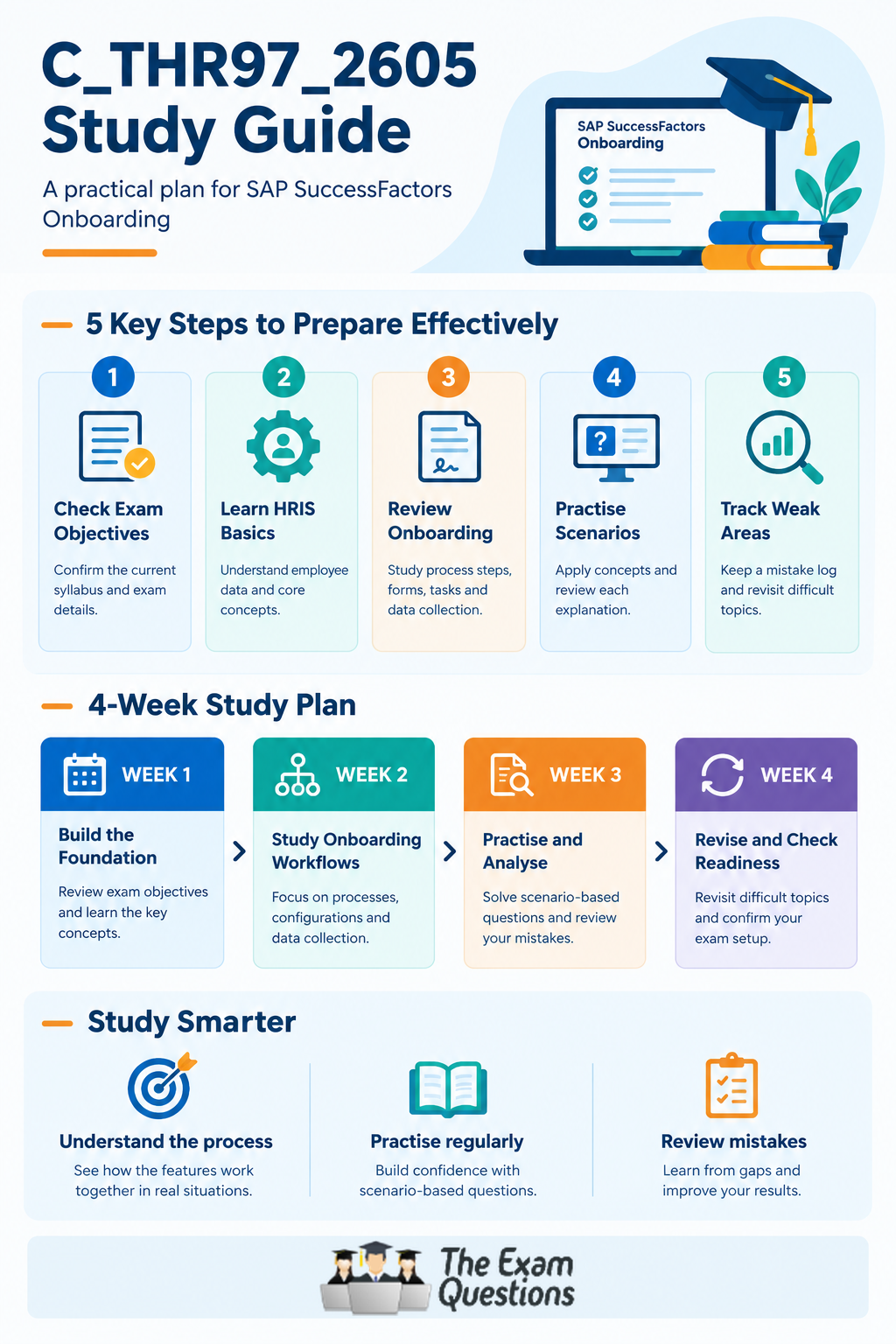
Week one builds the foundations. Review the official exam information, create a topic checklist, study HRIS fundamentals, and begin organizing your notes.
Week two focuses on onboarding and data. Work through employee onboarding, data modeling, and data collection, and watch how these topics connect in a complete workflow.
Week three covers integration and scenario practice. Study process integration and the remaining syllabus areas, complete practical exercises, explain your decisions, and note recurring mistakes.
Week four is for revision and readiness. Revisit difficult topics, test your understanding, and practice answering scenario-based prompts within a reasonable time limit. Check your technical setup and review the official exam requirements before your scheduled attempt.
Treat this plan as a starting point. Extend it if SAP SuccessFactors is new to you or if configuration concepts need more time.
Common study mistakes to avoid
Memorized answers can break when a scenario changes slightly, so focus on the reasoning behind each concept.
Weak HRIS knowledge makes onboarding configuration decisions harder to follow, so review the foundational topics whenever needed.
Old study notes may describe a different exam format or version. Check the official certification page before relying on them.
Many practice exercises help little when the same misunderstandings keep returning. Let incorrect answers guide your revision.
Practice works best when it starts early. Apply what you study throughout your preparation and let the syllabus and practice grow together.
Frequently asked questions
What is the C_THR97_2605 Study Guide used for?
It provides a framework for organizing exam preparation, reviewing the main SAP SuccessFactors Onboarding topics, and practicing how to apply concepts to practical situations.
Which topics should I prioritize?
Begin with the official exam objectives. HRIS, Employee Onboarding, Data Modeling, Data Collection, and Process Integration are the relevant areas listed on SAP's certification page.
Are practice questions enough to prepare?
Practice questions reveal weak areas, and they work best alongside official training material and practical study. Review the reasoning behind each answer so understanding stays ahead of recall.
How long does preparation take?
It depends on your SAP experience, familiarity with HR processes, and the time you have each week. A four-week schedule is a useful starting point, and some candidates may prefer a longer plan.
Conclusion
The best C_THR97_2605 Study Guide helps you understand how SAP SuccessFactors Onboarding works and how its concepts apply to real implementation situations. Let the official syllabus guide your studies, organize notes by topic, practice explaining your decisions, and review mistakes consistently.
Keep your plan realistic and verify the latest requirements directly with SAP before booking your exam. For additional preparation guidance, visit The Exam Questions and compare its information with the official SAP material.